
Jha introduces the “question ladder,” a five-level framework ranging from simple information retrieval to transformational questioning that challenges existing paradigms. Using a case study of the Ford F-150, she demonstrates how reframing a product brief from mechanical improvements to understanding user lifestyle needs can lead to significant design innovations. The session concludes with practical advice for leaders on fostering a culture of curiosity and using “question storming” to drive strategic breakthroughs.
An innovation strategist, Jha has led innovation teams and executive education for organizations like Ford, Cisco, and Harvard. Her work explores a central question: How do we expand human capacity to think, create, and make better decisions in an age of expanding intelligence?
Prapti Jha (In Her Own Words):
I’d love to present a new point of view on the work you’re doing within the expanding intelligence ecosystem we’re navigating today.
The Power of a Child’s Question
Let’s start with a story. In 1943, during a family vacation in Santa Fe, a four-year-old named Jennifer asked her father as he snapped her photo, “Daddy, why can’t I see the picture right away?” Of course, in 1943 photos required darkroom development—a lengthy, complex process. But that simple question led to the invention of the Polaroid camera. Jennifer’s father was Edwin Land, inventor of the instant camera.
Here’s what strikes me about this story: How many questions does a four-year-old normally ask? Countless. Yet as adults, the number of genuine questions we ask drops to nearly zero. I’m talking about genuine, open-ended, curious questions—not operational ones like, “When is the report due?” or “What’s the timeline on this?” Somewhere along the way, as we grow up, we stop asking curious questions. And that’s the shift that costs us. It costs us our creativity, innovation, and personal growth.
My first challenge to you: start asking more questions. Reclaim the volume you once had as a child. Ask about things that sometimes make you feel slightly embarrassed because you assume everyone else knows the answer—they probably don’t. Embracing a questioning mindset is a game changer, especially in the attention economy we inhabit.
Differentiating Your Thinking
But there is a second piece to this questioning imperative. One pattern I’ve noticed—particularly pronounced in this era—is that the teams that truly break through are never the ones with the most information. They are the ones asking a fundamentally different question than everyone else in their category. This leads to my core belief: in a world where execution is getting cheaper and faster, thinking becomes the differentiator.
Having answers isn’t the starting point anymore. Thinking is the differentiator, and questioning is the operating system for that thinking. It decides where your thinking is directed.
Let’s examine what’s been scarce across different eras. In the industrial age, the advantage went to whoever could produce at scale. In the knowledge era that followed, it was information—advantage went to whoever could access and organize it. That’s the age most organizations and professionals were designed and trained for. That’s why we have dashboards, reporting layers, and research functions as our day-to-day reality.
Now, when answers are essentially free thanks to artificial intelligence and other resources, questions become the new scarcity. Yes, you can generate hundreds of questions with any AI tool in seconds, but it’s still a human skill to know which ones actually matter.
From Question Storming to Strategic Selection
So where do you start? With question storming—generating volume first. Ask as many questions as possible. Go wide. Include the obvious ones because that’s where your brain naturally begins. Use AI to push you wider.
Whether you’re an individual contributor, working as a team, or a leader facilitating conversation, starting with questions opens up the canvas far more than any other approach. But here’s the critical part: don’t stop there. If you just create a questions list, you’ve only done the part that machines excel at. The next step is determining which questions deserve the quarter, the budget, your time, your career, your commitment, or your best people. That’s the part that will stay human for a really long time.
Here’s my most important message: in this era of expanding intelligence, generation is cheap. Selection is the job. That is becoming harder due to information overload and data of questionable accuracy, which makes judgment and selection even more crucial.
Creating a Culture of Curiosity
There are two moves when it comes to questioning: generation and selection. The first is volume—asking more questions. Ask the one that worries you might make you look less smart, because it won’t. Most of the time, other people in the same meeting also want to ask it but are too embarrassed. So create that culture of curiosity and questioning. If you’re a leader, scaffold and encourage it. If you’re leading a project, bring that attitude—it helps your team adopt the mindset and helps leaders notice your contribution differently.
But eventually, the volume plateaus. The question shifts to: which of these really deserves our time? That’s the second move—selection. Most of us have never thought about a method for this. How do we know which question is important? I’d love to share a map I use to understand where a question sits and how to prioritize it: the question ladder.
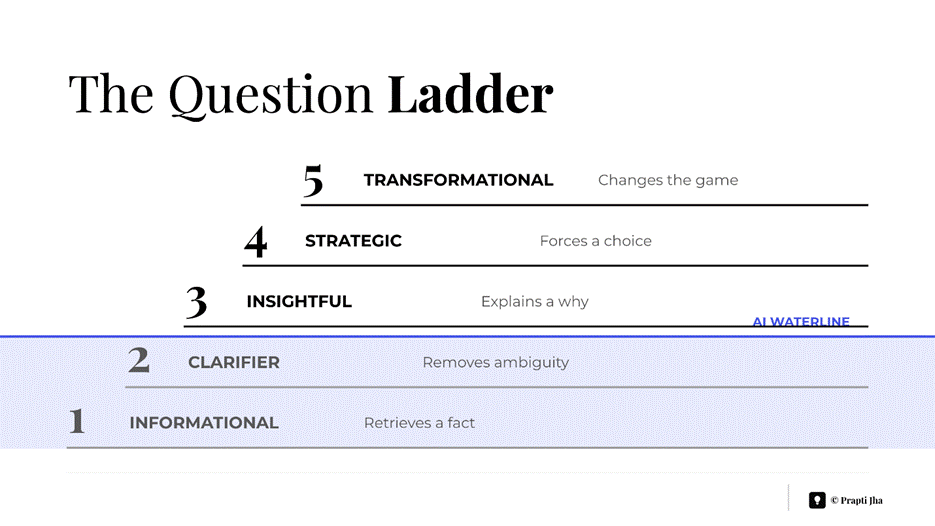
The Question Ladder: Five Levels of Inquiry
Every question you or your team asks sits on exactly one of these levels. To be clear, we need all five levels. This isn’t a ranking where top is good and bottom is bad—it’s a map of altitudes so we can see where we’re standing and whether that’s where the work actually needs us.
Level 1: Information — Retrieving facts. You can’t skip this layer, but understand it’s now fully automated. It’s meaningful for a team’s weekly work, but this work is being repriced—and not in humans’ favor, because it’s getting much cheaper and faster.
Level 2: Clarification — Sharpening a fuzzy question into a precise one. This is the difference between a useful number and a misleading one. Machines largely have this capability with some human intervention, but it still sits below what I call the “AI waterline”—meaning AI can already do it well or will very soon.
Level 3: Insight — This level asks “why.” AI is a genuine partner here, not an automator. It can spot patterns across hundreds of transcripts or data sets that would take us enormous time. It can propose why something is happening, but it cannot believe in one explanation or decide which is true. That’s still human judgment.
Level 4: Choice — This is about strategy—forcing a choice, helping people say “this, not that.” Strategy is fundamentally about what not to do. The test is whether your question helps you choose between two things. AI can lay out trade-offs beautifully and model opportunity cost, even play skeptic if you assign it that role. But it has no stake in the decision. That’s where humans still shine and where your value comes in.
Level 5: Transformation — This level attacks the frame itself. It questions what everyone has agreed on and stopped questioning. This can be dangerous because it can make six months of work look like you’ve been measuring the wrong thing—which is exactly why we rarely ask it. And exactly why it’s the most valuable question in today’s work. A lot of AI-generated work comes out looking so polished that we forget to ask: Is this really what we’re solving for? For example, instead of asking, “Why isn’t adoption going up?” ask “Is adoption even the right measure of value creation?” That completely reframes your thinking.
Elevating Your Questioning: The Ford F-150 Case Study
Let me show how climbing this ladder can shape a real product. This is one of my favorite case studies—how to design a better pickup truck.
The Ford F-150 has long been the bestselling pickup truck in North America and the most important product in Ford’s portfolio. When the team was asked to make the F-150 better for the next launch cycle, the brief seemed strategic but was actually a level one question.
Think about how you’d make a pickup truck better. Everywhere I’ve presented this, people say the same four things: more horsepower, more cargo, better towing capacity, and better fuel efficiency. These aren’t wrong—but they’re all level one answers to level one questions. AI can produce these in seconds with cost estimates attached.
The team reframed the brief entirely: “How do people use their trucks today?” This open-ended question moved beyond level one. As the team observed truck drivers actually using their vehicles—not just surveying them—they discovered something invisible: different users (moms with kids, small business owners) spend a large part of their life in their truck. It’s both a working space and a living space.
The reframed question became: How might we make the F-150 evolve to meet customers’ evolving needs and aspirations, both for current and future customers? Notice “evolving needs and aspirations”—not just horsepower or mechanics.
This led to breakthrough features: seats that fall fully flat so drivers could rest between jobs, and a storable gear shifter that creates a flat surface across the console—a workspace for laptops or lunch.
With the original brief—”design a better truck”—we’d never have arrived at these solutions. We’d have stayed in that room generating conventional answers about horsepower. With AI now in the picture, it can give you magnificent, well-cited, conventional answers. We might feel we’re doing great work. But the reframe was the work in this example. The reframe is the work we as innovators and leaders must do.
Leaping Forward with Questions
The question is the job. What question are we solving for, and how can we reframe it for the better?
Here’s what’s critical to remember: AI expands, you select. In innovation and research, we work across three phases: signals, insights, and bets. We scan for signals, look for insights, then decide where to place our bets. That’s how businesses function.
For signals, AI can scan more than we ever could. For insights, AI can generate five findings from the same data. For bets, it can generate more options than we typically have appetite for. All of that is real and useful.
But here’s what humans must bring at each stage:
At signals: relevance. There are countless signals—which ones actually matter to us? Filtering signal from noise is our selection work.
At insights: assumptions. What would have to be true for this reading to hold? What assumptions are we making based on our context, organization, people, and customers?
At bets: conviction. This is profoundly human—AI can’t replicate it. What will actually be at stake? We don’t want generic lists. We need to understand the nuances of people, organizational culture, and how things have moved previously. The same bet can function very differently in different organizations. Understanding those nuances remains deeply human.
Three Layers of Human Value
As we work across signals, insights, and bets, we bring three irreplaceable layers:
Context — What’s true for your organization that no model has access to. Even custom models can’t capture every nuance.
Judgment — Knowing which assumptions are load-bearing in your organization.
Ownership — Carrying the consequences of decisions over time.
If you skip relevance, you get information overload—signals and trends that overwhelm rather than inform. If you skip assumptions and judgment, you get the average view: well-written and researched, but something everyone else would say. If you skip conviction, you’re hedging small bets nobody’s responsible for—making incremental changes instead of leap changes.
This framework helps you orient where you are, what you bring, and how you work with expanding intelligence. The next time AI hands you something, ask: “Is it expanding? Am I supposed to be selecting? And if selecting, what am I selecting on?” This helps you ask the right questions for the right resource, context, and outcomes.
Let’s Talk Turkey
Let me end with a story. A mother and her daughter were cooking their first Thanksgiving dinner together. Before the turkey went into the oven, the mother chopped off the legs, placed them on top of the turkey, and put it in the oven. The little girl asked, “Mom, why did you do that?” The mother, exhausted from preparing dinner all day, shrugged and said, “That’s how my mom used to do it.”
Still puzzled, the little girl later asked her grandmother, “Grandmom, why do you chop off the turkey legs before putting it in the oven?” Again, her grandmother shrugged: “That’s how my mom used to do it.”
The little girl, still without an answer, eventually found her great-grandmother and asked, “Great-grandmom, why do you chop off the turkey legs and put them on top before putting the turkey in the oven?” The great-grandmom replied, “Well, dear, back when I cooked Thanksgiving dinner, my oven was really tiny and the whole turkey didn’t fit. So I had to chop off the legs, put them on top, and then fit it in.”
How many turkey legs are we chopping off just because “that’s how it’s always been done”?
What will be your next transformational question that changes the trajectory of your team or organization?