The Impact of AI on Innovation
The rapid implementation of AI in innovation seems to be shifting from experimental and pilot phases to the expectations of using a robust tool for ideation and other innovation capabilities. However, despite massive investment in AI, some analysts feel that they are not yet seeing a measurable or meaningful impact from these initiatives. Productivity and the influence of AI remain a bit uneven.
However, there is no doubt that AI is exploding in the world of innovation. AI isn’t a substitute for human skills but rather a multiplier of those skills, as Harvard Online puts it in a recent blog post. “What differentiates individuals and organizations is the ability to turn AI capability into business impact,” notes Harvard. “AI can generate options; humans still must decide what problems are worth solving. Companies need leadership—not automation.”
Still, the automation of some tedious tasks, and the speed with which AI operates, gives innovators a versatile new tool to play with.
In its article, “How AI is transforming innovation: three scenarios,” from the University of Oxford Said Business School, the paradox is encapsulated perfectly: “Innovation has historically been driven by human creativity, experience, intuition, and need, on one hand, and by institutional processes of recombination, on the other. Today, artificial intelligence (AI) tools are altering this landscape in basic ways, not simply as a supportive tool but as an active contributor, reshaping how ideas are generated, become innovations, and are evaluated and scaled for impact.”
Three AI-Innovation Pathways
When looking at AI’s impact on innovation in all its forms, one must look not only at it creatively but also all the processes that form innovation on the corporate scale.
Oxford writes, “The capacity of AI tools to analyze vast datasets, identify patterns, pluralize these, and generate novel insights underscores current ways that AI tools may work as catalysts for innovation across industries from pharmaceuticals to finance, from space commerce to creative sectors. This development signifies more than only technological innovation or advance. Rather, this points to potential structural and philosophical debate about the futures for human creativity, social process and governance in innovation.”
AI’s impact is fluid, Oxford observes, depending on the maturity of the AI, access to quality data, and the overall integration with a company’s systems. Oxford further breaks down AI into three plausible scenarios for its use in innovation:
Scenario 1: AI-assisted innovation (contemporary and already in use): AI primarily enhances human-led processes by optimizing tasks such as data analysis and predictive modeling. In fields like drug discovery and financial risk assessment, AI accelerates the innovation cycle but remains a tool dependent on human direction. The outcome: Incremental improvements and efficiency gains, constrained by local data and human cognition.
Scenario 2: AI-augmented co-founder (emerging): AI progresses from assistant to an active collaborator, influencing strategic decisions and innovation processes. Entrepreneurs and researchers now rely on AI for real-time insights, hypothesis validation, and adaptive learning, forming a symbiotic relationship between humans and machines. Crucially, this scenario leverages multi-agent systems, where multiple intelligent AI agents collaborate, communicate, and negotiate with each other to solve complex problems and optimize outcomes. This advanced integration supports adaptive and dynamic decision-making across various stages of innovation. The outcome: Accelerated innovation with significantly improved market responsiveness, effectiveness, and scalability through sophisticated agent collaboration.
Scenario 3: AI-enabled autonomous innovation (future): Looking further ahead, AI could autonomously identify problems, generate innovative solutions, and execute strategies independently. This would represent a profound transformation in innovation ecosystems, potentially operating without human intervention. Humans would operate primarily as oversight, addressing ethical and existential concerns. The outcome: Highly decentralized, personalized, and efficient innovation ecosystems.
Leveraging AI As an Ideation Multiplier
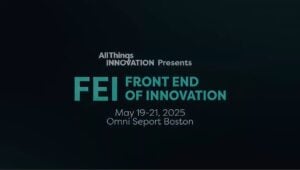
The FEI: Innovation Summit will be held October 5-6, 2026, at The Colorado Convention Center, Denver. The summit will be co-located with TMRE.
The session, “Innovation X: AI as Ideation Multiplier,” will be presented by Chris Gurr, FEI Pod Leader at Newell Co.
What happens when you redesign innovation around generative AI? At Newell Brands, it created a faster, more connected approach to idea development. Gurr will share how InnoGEN, an award-winning internal approach, helped teams strengthen synthesis, expand creative exploration, and move from early signals to actionable concepts with greater speed and confidence.
By accelerating learning, leveraging digital teams and winning leadership advocacy, the approach helped teams rethink how insights, exploration, and concept development work together at the Front End of Innovation. This session will unpack the model, the adoption journey, and the practical ways FEI teams can apply these tools today to improve innovation quality, increase throughput, and unlock bigger ideas faster.
Click here for more information about the FEI: Innovation Summit
Navigating the AI Frontier
In many ways, AI is democratizing innovation across the organization, lowering the barrier and fostering engagement. AI isn’t just enhancing innovation but in the emerging future, may very well redefine who or what innovates.
“Successfully navigating this AI-driven landscape requires rethinking strategies to ensure ethical, responsible, and inclusive technological advancement,” notes Oxford. “The future of innovation will belong to those prepared to integrate AI thoughtfully, maximizing human potential while addressing emerging challenges. Embracing AI responsibly will not only improve organizational effectiveness but also enhance global socio-economic progress, making innovation more inclusive and impactful.”
Video: “The AI Creativity Multiplier: 5 Steps to Amplify Your Innovative Thinking,” courtesy of Phil McKinney.