Defining Disruption
So, just what is a disruptor brand? For McKinsey, which earlier this year studied disruptor traits through the lens of consumer-packaged goods, these brands are defined by their rapid, outsize growth. They are also connecting deeply with consumers and reshaping the competitive landscape.
McKinsey notes, “While the emergence of smaller brands began before the pandemic, their presence has accelerated in the past two to three years. In categories ranging from salty snacks and beverages to vitamins and supplements, disruptors are accounting for a growing share of total category expansion. Incumbents, long buffered by their scale and long-term brand equity, are now struggling to keep pace with changing consumer expectations and faster-moving competitors.”
In the article, “What consumer-packaged-goods companies can learn from disruptor brands,” McKinsey identifies that the disruptive mindset of these brands, and the agility they bring to the table, can outweigh the scale of larger brands in the category. This can influence the types of marketing being conducted, product innovation cycles, and the overall pace of innovation.
Consumers are also more willing to try out new brands during their shopping trips and retailers in turn are carrying more disruptor brands than ever before. The risk of introducing new brands to consumers, correspondingly, has decreased as it’s become less expensive to enter categories, and so retailers are willing to bet bigger on new brands.
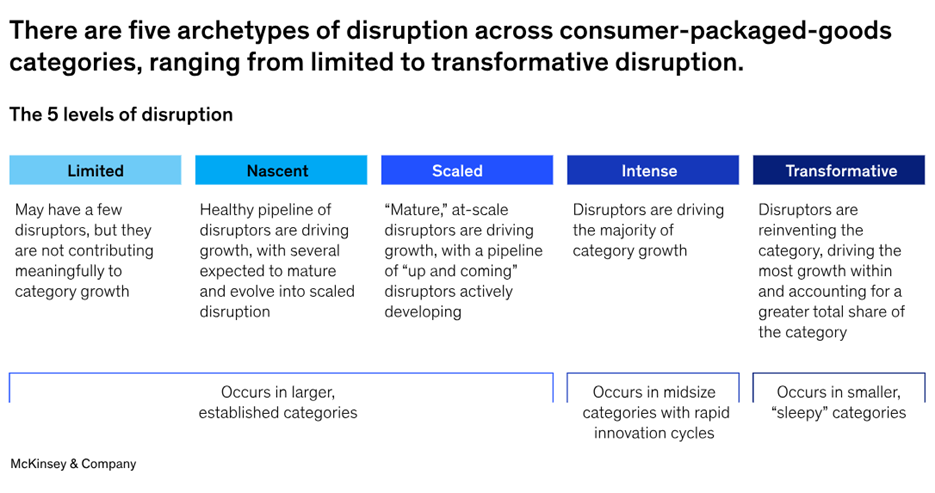
Disruption in CPG falls into five distinct archetypes based on category size, maturity, and the speed at which innovation occurs: limited disruption, nascent disruption, scaled disruption, intense disruption, and transformative disruption (see the table from McKinsey below):
Distinguishing Disruptor Brand Characteristics
The archetypes above show that innovation is not a uniform phenomenon, notes McKinsey, and it takes different forms depending on category size, maturity, and innovation speed. That being said, McKinsey identifies six traits that consistently distinguish disruptor brands and explain how they achieve outsize growth:
- Bold and culturally relevant messaging: Disruptors reach consumers with a bold, original, or novel message on social media and across digital platforms, leaning into cultural conversations to stay relevant. Their marketing evolves in real time with the communities they engage. By using data analytics, social listening platforms, and AI-powered sentiment and trend tools, incumbents can uncover what’s shaping consumer conversations in real time. Translating those insights into creative marketing that reflects the culture and deploying it dynamically through personalized content engines and automated media tools allows them to reach the right audience at the right moment.
- Unique physical sales strategy: Consumers today discover brands both online and in person, meaning real-world activations remain as critical as digital ones. Disruptor brands are making their mark in the physical world in unexpected ways—whether as one of the few branded options on a shelf dominated by private labels; through booths at consumer events, concerts, or conferences; via immersive pop-up experiences; or even in airports with experiential points of sale. Whatever the form, the key for disruptor brands is to engage consumers and seamlessly connect the in-person experience to the broader purchase journey—through tactics such as email sign-ups, QR code activations, loyalty program enrollment, or social-sharing incentives. Doing so helps break through the noise of the crowded CPG landscape and build authentic, enduring connections with consumers.
- Distinctive product innovation: At the product level, disruptors continuously experiment with new and creative formulations, packaging, form factors, and benefit combinations, often with a relentless focus on cocreating with communities. This constant iteration keeps them closely aligned with emerging consumer preferences. Incumbents can use AI-driven insight platforms, digital prototyping, and small-batch production to test and refine new formulations, packaging, and benefits at speed—while actively cocreating with consumer communities through social listening and feedback loops. By embedding digital tools across the innovation process—from concept generation to in-market testing—companies can shorten development cycles, scale ideas faster, and stay in lockstep with evolving consumer preferences.
- Digital fluency: A digital-first DNA underpins everything disruptors do. They leverage digital channels for marketing, customer acquisition, and community building, relying heavily on social, direct-to-consumer (D2C), and influencer ecosystems to reach and retain their audiences. To rewire their organizations for the digital era, CPG incumbents could build cross-functional marketing “pods” that unite data scientists, creatives, and channel experts to act in real time; invest in modern martech and automation tools to personalize engagement across social, D2C, and influencer channels; and empower teams with agile ways of working so they can test, learn, and optimize campaigns continuously.
- Speed and agility: Disruptors are agile, able to rapidly react and adapt to consumer and market signals and to nimbly change direction on product, pricing, and marketing. They remain open to disruptive partnerships and collaborations that help them move faster and stay ahead. To replicate this, incumbents should embrace a start-up mindset and “fail fast” experimentation—for example, by building and testing minimum viable products and scaling what works.
- Consumer-centric purpose: Finally, the purpose of disruptor brands is clear to consumers. Each meets an unmet or deeply felt need from consumers, anchored by a mission that aligns closely with consumer values. Incumbents can pair their scale and data sophistication to uncover what’s driving new consumer priorities and preferences—why people are choosing to buy less, buy differently, or pay more for perceived value. By combining quantitative signals from AI and social listening with qualitative insights from community cocreation and feedback loops, they can identify growth areas—such as wellness, functional nutrition, and better-for-you products—and translate them into purpose-led innovation that builds lasting trust.
Thriving in the Disruptor Brand Era
While the McKinsey article focused on CPG brands, the lessons here can be leveraged for the ways disruptive brands can operate in many product and service categories. The flexibility and speed at which these types of brands operate should be noted in terms of how disruptive they may (or may not) be. It doesn’t necessarily mean that disruptors always hold the advantage over larger, more established brands. But if one lesson is held true in the marketplace: Never stand still.
As McKinsey notes, “To thrive in this new environment, incumbents should stay relentlessly consumer-obsessed, use technology to detect and respond to emerging trends, and rethink their innovation and marketing playbooks. The disruptor era represents a fundamental shift in how growth happens in CPG. The brands that learn from today’s disruptors will be the ones leading tomorrow’s growth.”
Video: “CPG Brands Have Gotten Innovation Drunk | Managing Innovation Risk,” courtesy of Joshua Schall Consulting.